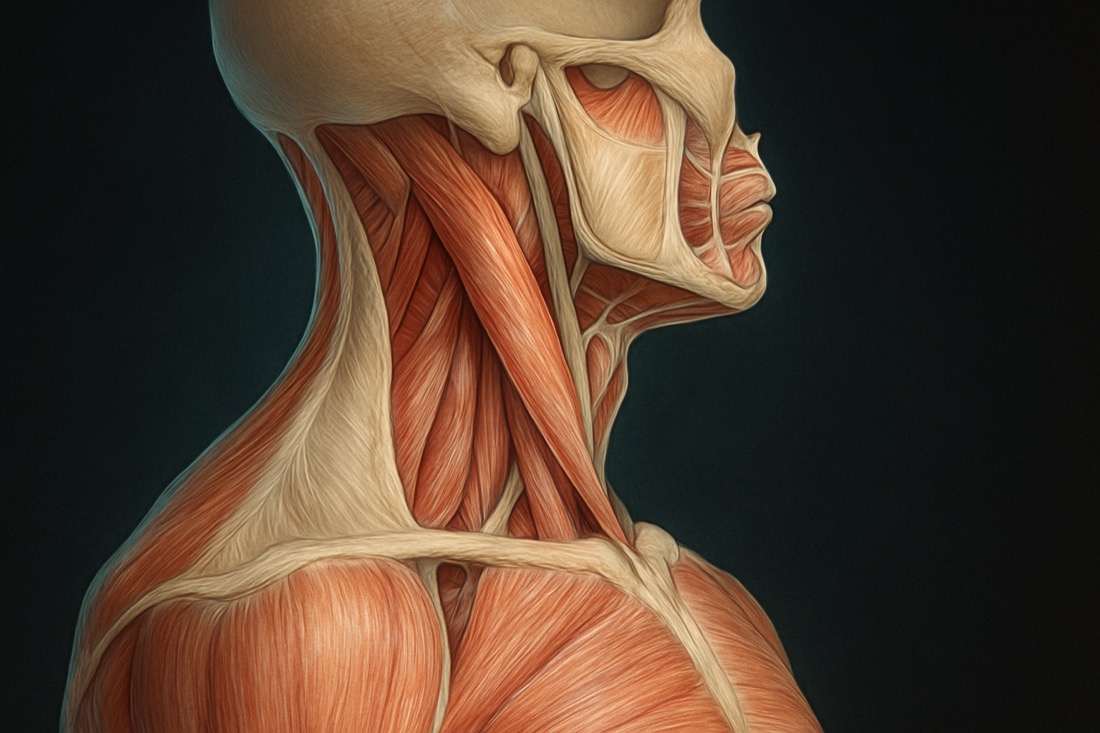
Shogo Fujii's Instant Treatment Demo — Can You Tell When to Stop?
Original title (JP): 【藤井翔悟のその場で治す治療デモ】この引き際がわかるか?

Supervised by
Shogo Fujii
Physiotherapist (PT) · Founder of the SHOGO FUJII® FASCIA METHOD
View profile →Clinical Article · 6 min read
Fascia release for shoulder and elbow pain works best when it follows careful screening rather than a fixed routine. In this treatment demonstration, physical therapist Shogo Fujii assesses a patient with a painful, swollen right shoulder and elbow, then releases only the tissues that are safe to touch. This article explains the reasoning behind each step, so that clinicians and informed patients can understand what fascia release involves, when it is gentle, and when it should wait. It is educational, not personal medical advice.
How does fascia release for shoulder and elbow pain start?
Before any hands-on work, the therapist checks how the person moves. In the demo, the patient raises both arms overhead and bends the elbow, and the therapist asks exactly where it hurts. The aim is to separate several possibilities: pain from tissue tightness, pain from active inflammation, and pain from structural damage [1].
Pain scores matter. The elbow was rated about 10 out of 10 at its worst, which Fujii treats as a warning sign. Pain that high can mean structural damage or an early repair phase, so the approach has to be cautious [2]. The shoulder was rated around 6. The therapist also compares the painful side with the healthy side, looking at joint play, the deltoid, the area around the collarbone and the surrounding muscles.
He also asks about the history: whether there was an injury with a strong force, whether the person has had numbness or tingling, and how they reacted to past stretching, massage or release. A very sensitive person who flares up after ordinary massage may not be a candidate for hands-on work that day.
Why does swelling change what a therapist can do?
Heat, puffiness and a soft, spongy feel under the hands suggest fluid and inflammation. In the demo the therapist notes warmth on the back of the hand and a boggy texture, and decides that aggressive pressure would be unwise. When tissue is swollen, strong release techniques can aggravate it, so the work is limited to light, nearby tissue and gentle fluid-moving techniques [3].
Fujii also tests scapular mobility, noticing a loose, springy quality. He uses this feel to decide how much to do on the day. Inflammation is described as part of the early body response, so the goal is not to force a change, but to reduce secondary tightness that adds to the pain.
This is why the same technique can look very different from patient to patient. Judgment about what to leave alone is a core skill.
What is the quadrilateral space, and why is it targeted?
The quadrilateral space is a small gap bordered by the teres minor, teres major, the long head of the triceps and the humerus. Nerves and vessels pass through it, and Fujii describes it as a place where lymphatic congestion and swelling around the upper arm often build up. He had the patient search for it as a self-care landmark [4].
With the patient lying on their side, he released the tight tissue gently, while asking the person to breathe out slowly. He chose this region because, with pain high and range of motion limited, working the nearby, shortened tissue and using connections in the fascia was more realistic than moving the joint through its range.
After this stage, the patient raised the arm again and reported that it felt noticeably lighter. The therapist's interpretation was that muscle spasm, not only inflammation, had been contributing to the pain. This is one clinician's reading of a single session, not proof that the technique works for everyone.
Which muscles around the shoulder and elbow were released?
Three areas were addressed at the shoulder: spasm in the subscapularis, shortening of the serratus anterior, and tightness around the quadrilateral space. Fujii asked the patient to breathe out during each release and re-tested movement afterwards.
At the elbow, he worked on the forearm extensors and flexors, including the brachioradialis and the muscles on the thumb side, plus the fascial planes between the biceps and triceps (the intermuscular septum). He also gently guided the radial head, since the elbow felt slightly displaced, and released the thumb-side tissue. After this, the patient could bend the elbow further and said the pain was still present but no longer stopped movement [5].
Overhead reach also felt easier. Fujii stressed that results need to be watched over time, and that reducing inflammation, rest, sleep, stress and recovery capacity all affect progress [6].
Frequently asked questions
Is fascia release safe when a joint is swollen and very painful? — It depends on the findings. Marked swelling, heat, numbness or severe pain call for screening first, and often a lighter approach focused on nearby tissue rather than the sore joint. Anyone with a recent injury or neurological symptoms should see a clinician before trying release techniques.
Can I do self-care between sessions? — In the demo, Fujii suggested searching for the quadrilateral space, the subscapularis, the serratus anterior and the forearm muscles, and using gentle ball pressure or light movement. Pressure should stay comfortable, and a muscle that is unfamiliar to you is worth looking up or asking a professional about first.
Will fascia release fix shoulder and elbow pain on its own? — No guarantee can be made. The demo showed an immediate gain in movement, but the therapist noted that pain remained and that follow-up was needed. Lasting change usually depends on inflammation settling, tissue healing and the underlying cause being addressed.
References
- [1]Ricciotti E, FitzGerald GA. Prostaglandins and inflammation. Arterioscler Thromb Vasc Biol. 2011;31(5):986–1000.
- [2]Salehi B, Venditti A, Sharifi-Rad M, et al. The therapeutic potential of apigenin. Int J Mol Sci. 2019;20(6):1305.
- [3]Field R, Pourkazemi F, Turton J, Rooney K. Dietary interventions are beneficial for patients with chronic pain: a systematic review with meta-analysis. Pain Med. 2021;22(3):694–714.
- [4]Taljanovic MS, Gimber LH, Becker GW, et al. Shear-wave elastography: basic physics and musculoskeletal applications. RadioGraphics. 2017;37(3):855–870.
- [5]Langevin HM. Connective tissue: a body-wide signaling network? Med Hypotheses. 2006;66(6):1074–1077.
- [6]Schleip R. Fascial plasticity — a new neurobiological explanation. J Bodyw Mov Ther. 2003;7(1):11–19.
Related videos
Palpation X-Ray #84 | Is the Sacrum Really a Flat Plate? It's a Wedge, Wide at the Top and Narrowing Downward — Trace Down from the Lumbar Spine and Confirm at Gluteus Maximus
0:56
Dramatic Improvement in One Session: Manual Approach to the Pelvic Girdle, with Palpation of Anatomical Landmarks and Movement Assessment Before and After (Hands-On Demo)
5:48